Daniel’s Prophecies Understanding Ancient Wisdom for Modern End Times
The Book of Daniel isn’t just another ancient text collecting dust on theological shelves. Instead, it’s become a roadmap that millions consult when trying to make sense of our turbulent world. Whether you’re a seasoned Bible scholar or someone who’s just curious about prophecy, Daniel’s visions offer something remarkable: a bridge between the past and our present moment.
Now, here’s what makes this ancient prophet’s writings so compelling. Unlike vague predictions that could mean anything to anyone, Daniel’s prophecies paint specific pictures with striking detail. Moreover, they’ve sparked countless discussions about their relevance to current events, from geopolitical shifts to technological breakthroughs that seem ripped from science fiction.
Who Was Daniel and Why Should We Listen to His Prophecies Today
Daniel wasn’t your typical prophet. As a teenager, he was torn from his homeland during the Babylonian conquest of Jerusalem around 605 BC. Yet, rather than becoming bitter or defeated, he rose to become one of the most trusted advisors in two world empires. His story reads like a thriller, complete with political intrigue, death sentences, and miraculous escapes.
What sets Daniel apart, however, is his track record. His interpretation of King Nebuchadnezzar’s dream about four kingdoms materialized with stunning accuracy. Furthermore, his vision of seventy weeks precisely predicted significant events in Jewish history. Consequently, even skeptics acknowledge that something unusual happened with Daniel’s prophetic gift.
Today’s readers connect with Daniel because he lived through chaos remarkably similar to ours. He witnessed the collapse of his nation, survived under hostile governments, and maintained his faith despite constant pressure to compromise. Sound familiar? That’s precisely why his message resonates across millennia.
Breaking Down the Four Kingdoms Prophecy in Daniel Chapter 2
Let’s dive into Daniel’s most famous vision: the statue with the golden head. King Nebuchadnezzar dreamed of a massive image with a head of gold, chest of silver, belly of bronze, legs of iron, and feet of mixed iron and clay. Daniel explained that each section represented successive world empires.
Most biblical scholars identify these kingdoms as Babylon (gold), Medo-Persia (silver), Greece (bronze), and Rome (iron). The progression isn’t random, either. Each empire was larger and stronger than its predecessor, yet somehow less glorious. Think of it this way: gold is beautiful but soft, while iron is strong but common.
The really intriguing part? Those feet of iron mixed with clay. Daniel prophesied that the final kingdom would be divided, partly strong and partly brittle. Many interpreters see connections to our modern world, where nations form alliances yet struggle to truly unite. The European Union, for instance, has sparked numerous debates about whether it fulfills this ancient prediction.
Key Insight: The stone that smashes the statue “without human hands” represents a divine kingdom that replaces all earthly governments. This detail has profound implications for how we view current political developments.
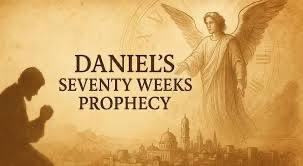
Daniel’s Seventy Weeks Vision and End Times Timeline
Chapter 9 contains what many consider the Bible’s most precise prophecy. Daniel received a vision of “seventy weeks” decreed for his people and the holy city. Now, here’s where it gets technical but fascinating: in prophetic language, these “weeks” represent periods of seven years each.
The prophecy predicted exactly when the Messiah would appear and be “cut off” (a reference to crucifixion). Historical records show that Jesus entered Jerusalem on what’s called Palm Sunday at precisely the time Daniel’s prophecy indicated. The mathematical precision is stunning when you break it down.
Nevertheless, there’s a gap in the prophecy that fuels much end times speculation. After sixty-nine weeks, the prophetic clock stopped, leaving one final “week” unfulfilled. This seven-year period is what many scholars identify as the coming tribulation. During this time, Daniel describes a ruler who makes a covenant with many, then breaks it halfway through.
The Little Horn and Antichrist Connections in Modern Prophecy
Daniel’s visions repeatedly feature a mysterious figure called “the little horn” who speaks boastfully and persecutes believers. Chapter 7 describes this character with eerie detail: he rises among ten horns (kingdoms), subdues three of them, and wages war against God’s people for “a time, times, and half a time.”
Fast forward to today’s world, and you’ll find endless speculation about who this figure might be. Some point to rising global leaders, others to technological systems that could enable worldwide control. What’s undeniable is that the description matches what the New Testament calls the Antichrist.
However, before we get carried away with speculation, it’s worth noting what Daniel emphasizes: this figure’s reign is temporary and ends in spectacular defeat. The Ancient of Days judges him, and his kingdom is given to the saints. This isn’t a story about evil winning, but about its ultimate destruction.
Applying Daniel’s Prophecies to Personal Growth and Faith
Here’s something often overlooked in prophecy discussions: Daniel wasn’t just predicting future events. He was showing us how to live faithfully in hostile environments. His life demonstrates practical wisdom that applies whether we’re facing the end times or just a difficult Tuesday.
First, Daniel maintained his prayer life despite knowing it could cost him everything. When officials passed a law forbidding prayer to anyone but the king, he kept his window open and prayed as usual. That’s not recklessness; that’s prioritizing what matters most regardless of consequences.
Second, he combined spiritual devotion with practical excellence. Daniel didn’t use his faith as an excuse for mediocrity. Instead, he became so valuable to the empire that even his enemies couldn’t find fault with his work. This balance challenges us to be both heavenly minded and earthly good.
Moreover, Daniel showed us how to interpret our times without becoming fearful or fatalistic. Yes, he saw visions of tumultuous events ahead. Yet his response wasn’t panic but persistent faithfulness. Understanding prophecy should empower us, not paralyze us with anxiety.
Common Misconceptions About Daniel’s End Times Prophecies
Let’s address some myths that cloud discussions about Daniel’s prophecies. First, not everything in Daniel is about the distant future. Some prophecies were fulfilled in history, like the rise and fall of specific empires. Recognizing what’s already happened helps us better understand what might still be coming.
Another misconception is that understanding prophecy requires advanced theological training. While scholarly insights help, Daniel’s core messages are accessible to anyone willing to read carefully. The prophet himself was told that understanding would increase as the end approaches, suggesting that clarity comes progressively.
Additionally, many assume that prophecy study is only about predicting dates and identifying the Antichrist. Daniel’s purpose was deeper: encouraging faithfulness during difficult times and assuring readers that God remains sovereign over human history. When we miss this, we turn prophecy into a puzzle rather than the encouragement it was meant to be.
How Current World Events Align With Daniel’s Visions
Today’s geopolitical landscape offers intriguing parallels to Daniel’s prophecies. The reformation of Israel as a nation in 1948 marked a pivotal moment that many see as prophetically significant. After nearly two thousand years of dispersion, the Jewish people returned to their homeland, just as ancient prophets predicted.
Furthermore, the rise of global interconnectedness through technology creates possibilities that ancient empires could never achieve. Surveillance systems, digital currencies, and instant worldwide communication all enable the kind of control Daniel described. Whether we’re witnessing the fulfillment of prophecy or just technological progress remains a matter of interpretation.
Nevertheless, we should approach current events with humble discernment rather than dogmatic certainty. History is littered with confident predictions that turned out wrong. What we can say is that the conditions Daniel described are increasingly plausible in ways previous generations couldn’t imagine.
Ready to Go Deeper Into Biblical Prophecy?
Discover how ancient prophecies connect to your personal journey and modern life. Explore resources that bridge biblical wisdom with practical spiritual growth.
Practical Steps for Studying Daniel’s Prophecies Effectively
If you’re ready to dig deeper into Daniel’s writings, start with the narrative sections (chapters 1-6) before tackling the visions. Understanding Daniel’s character and historical context makes the prophecies much clearer. These stories aren’t just entertaining; they establish the foundation for everything that follows.
Next, read multiple translations and commentaries to get different perspectives. Daniel’s Hebrew and Aramaic text contains nuances that single translations can miss. Don’t feel intimidated by scholarly resources; many are written for general audiences and provide valuable insights without requiring seminary training.
Finally, connect prophecy study with prayer and reflection. Daniel himself received understanding through seeking God, not just analyzing texts. The goal isn’t to become a prophecy expert but to grow in faith and wisdom. When studied properly, Daniel’s prophecies should make us more confident in God’s sovereignty, not more anxious about the future.
Why Daniel’s Message Matters More Than Ever
We live in unprecedented times. Technology reshapes society faster than we can process the changes. Global tensions escalate while traditional institutions crumble. Environmental concerns, pandemics, and economic instability create a perfect storm of uncertainty. Sound overwhelming? That’s precisely when Daniel’s message becomes essential.
The prophet shows us that chaos isn’t random. Behind the apparent disorder, a divine plan unfolds with precision. Kingdoms rise and fall according to schedule. Evil appears triumphant temporarily, but justice ultimately prevails. This perspective doesn’t eliminate difficulty, but it transforms how we navigate uncertain times.
Moreover, Daniel demonstrates that individuals can make a difference even when systems fail. You don’t need political power or social influence to live faithfully. One person committed to integrity and prayer can impact nations, as Daniel’s life proves. His example challenges our tendency to feel helpless in the face of massive global forces.
In conclusion, Daniel’s prophecies aren’t just about predicting the future. They’re about understanding the present through heaven’s lens. Whether we’re witnessing the final chapter of human history or just another turbulent season, Daniel’s wisdom guides us toward faithful living. His prophecies remind us that no matter how dark things appear, the story has already been written, and light wins.
The question isn’t whether Daniel’s prophecies are relevant to modern end times. The question is whether we’ll apply their wisdom to our daily lives. Will we, like Daniel, choose faithfulness regardless of circumstances? Will we study these ancient texts not just for information but for transformation? That’s the challenge Daniel’s prophecies present to every generation, including ours.